I lead the class discussion over two readings covering the areas of both special education and bilingual education, including Hochschild & Scovronick’s chapter on separation and inclusion from their book The American Dream and Public Schools and Olneck’s article “What Have Immigrants Wanted From American Schools? What Do They Want Now? Historical and Contemporary Perspectives on Immigrants, Language and American Schooling.” I offered the group a list of 35 traits of special ed and bilingual ed and asked the class to divide them according to what they felt were controversies and successes of each, without repeating topics. The relay of this information was done electronically, with a goal to construct a real time web of concepts utilizing bubble.us to showcase a potential technology to my cohort fellows. The map that they constructed during the discussion is below:
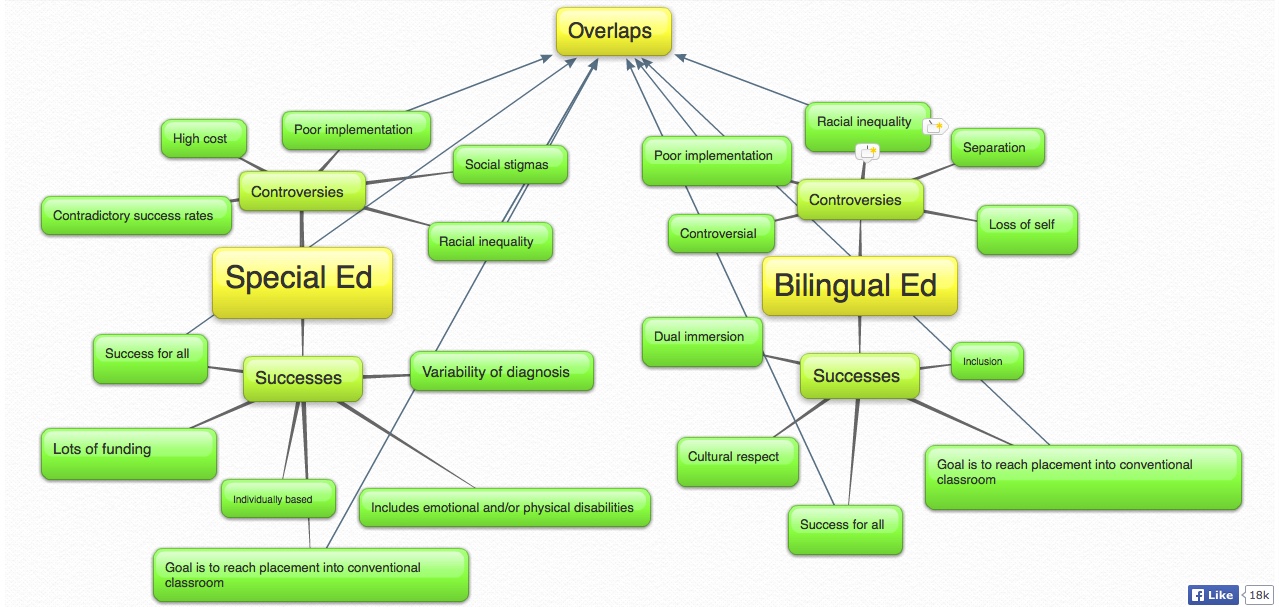
I felt more confident leading this discussion than during any other presentation this term. I think this was the result of all of those chemistry mini lessons that I taught, coupled with the fact that I had a good hold on the material. I am finding that the more well versed I am with topics, the more confident I feel leading discussions on them.
HLP 2 was utilized to its fullest extent in order to complete this assignment. It was my first attempt at leading a discussion with this group, and it was nice to be able to guide the discussion so that everyone had the opportunity to speak. InTASC 3 was used for this discussion as I divided my classmates up and presented them ideas to discuss and sort according successes and controversies of special ed and bilingual ed. InTASC 5 overlapped with InTASC 3 here in that differing perspectives collaborated in completing this task while InTASC 10 was covered by myself facilitating the discussion.
It was interesting to watch the other Fellows present their readings to the class, and seeing what discussion techniques worked best. I felt that each one of our presentations represented our personalities well, and in turn our future teaching styles.